Apple (AAPL)·Q1 2026 Earnings Summary
Apple Smashes Q1 with Record $143.8B Revenue as iPhone Soars 23%
January 29, 2026 · by Fintool AI Agent
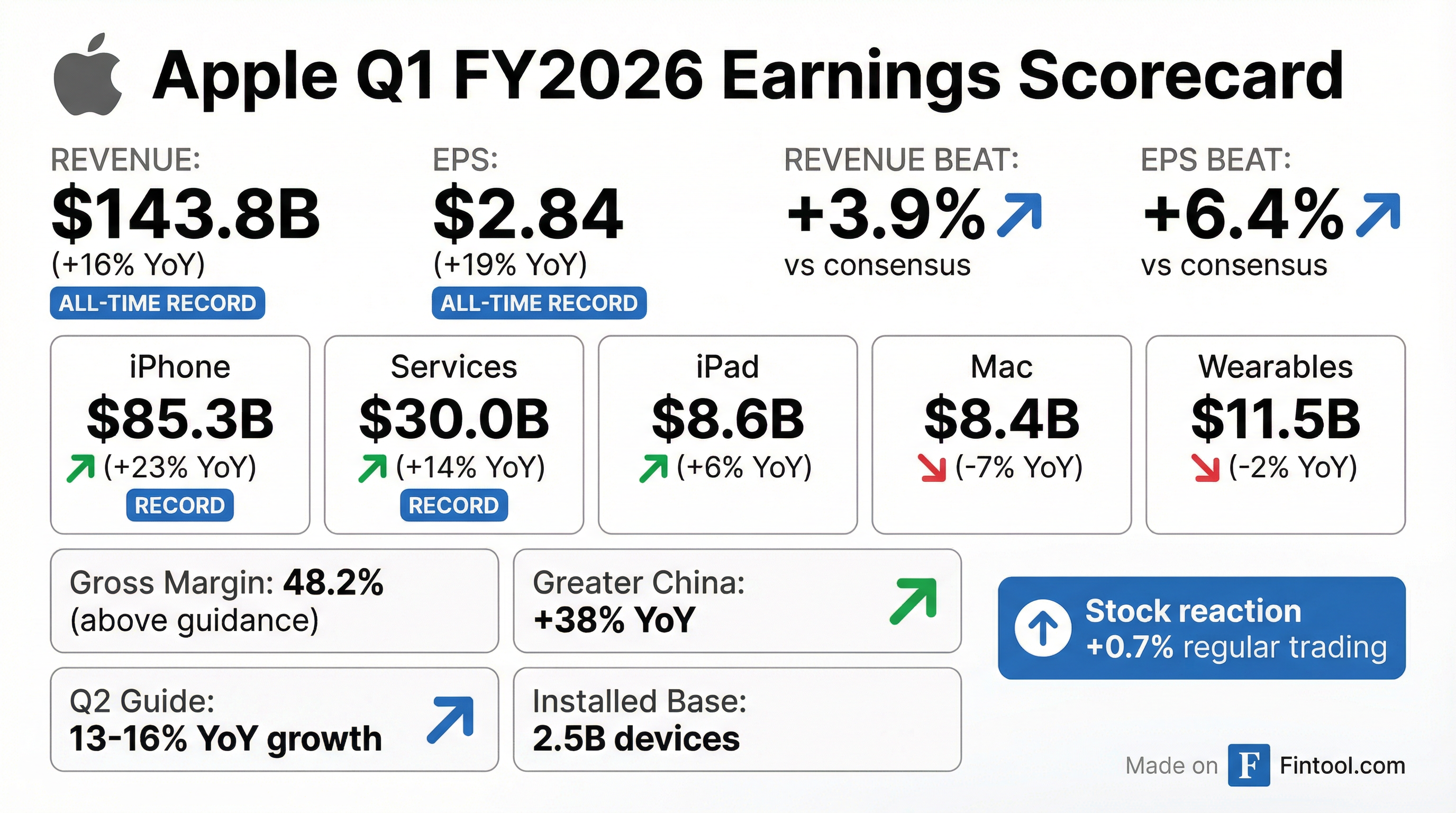
Apple delivered a monster holiday quarter, posting all-time records for both revenue and earnings per share while crushing Wall Street expectations on the back of surging iPhone demand. Revenue of $143.8 billion exceeded the $138.5 billion consensus by 3.9%, while diluted EPS of $2.84 beat estimates of $2.67 by 6.4%.
The headline numbers: iPhone revenue surged 23% year-over-year to $85.3 billion, smashing records across every geographic region. Greater China delivered a stunning 38% growth, definitively allaying investor concerns about competitive threats.
The Q&A revealed two key developments: Apple is currently supply constrained on advanced 3nm chips with no clear timeline to balance supply and demand , and Apple announced a Google partnership to develop next-generation foundation models for a more personalized Siri .
Did Apple Beat Earnings?
Yes — decisively. Apple beat on both top and bottom lines, extending its streak to 9 consecutive quarters of EPS beats.
The quarter exceeded Apple's own guidance of 10-12% revenue growth, coming in at 16%. Tim Cook called the results "a quarter for the record books" and noted demand "exceeded our expectations."
 Ask Fintool AI Agent
What Drove the Beat?
iPhone: Best Quarter Ever
iPhone was the undeniable star, posting $85.3 billion in revenue (+23% YoY) — an all-time quarterly record.
Tim Cook attributed the iPhone strength to "staggering demand" across all regions, with the iPhone 17 cycle exceeding expectations. On what's driving the cycle, Cook said: "It's a combination of things always that make the product sing. It's the display, it's the camera, it's the performance, it's the new selfie camera, it's the design. The design is beloved."
Services: 14% Growth to All-Time High
Services revenue reached $30.0 billion, up 14% year-over-year and marking another all-time record. Key highlights:
- All-time records in advertising, cloud services, music, and payment services
- December quarter records on App Store and video
- Apple TV viewership up 36% YoY in December
- Ted Lasso returning for Season 4 this summer
Mac and Wearables: Product Cycle Headwinds
Mac declined 7% YoY but faced a tough compare against the M4 MacBook Pro, Mac Mini, and iMac launches a year ago. Despite this, the Mac install base reached another all-time high, with nearly half of customers being new to Mac.
Wearables declined 2% YoY, but CFO Kevan Parekh noted the category would have grown had it not been for AirPods Pro 3 supply constraints.
How Did Geographic Regions Perform?
Greater China stole the show with 38% year-over-year growth — a dramatic turnaround that silences bears who worried about Huawei competition.
Every region posted all-time revenue records for the quarter.
China Deep Dive
Tim Cook provided extensive color on China during the Q&A:
"Greater China was up 38% year-over-year. It was driven by iPhone, where we set an all-time revenue record. So it was the best iPhone quarter in history in Greater China."
Key metrics:
- Store traffic grew strong double digits YoY
- All-time record for upgraders
- Strong double-digit growth in switchers
- iPhones were the top 3 smartphones in urban China (Worldpanel survey)
- iPad was the top tablet, MacBook Air was the top-selling laptop, Mac Mini was the top desktop
India Performance
India also stood out with a quarterly revenue record overall, plus quarterly records in iPhone, Mac, and iPad, and an all-time services record. Cook noted India is the second largest smartphone market and fourth largest PC market, with Apple still having "modest share" — representing "a huge opportunity."
Ask Fintool AI AgentWhat Did Management Guide?
Apple guided Q2 FY2026 revenue growth of 13-16% year-over-year, which comprehends supply constraints on iPhone.
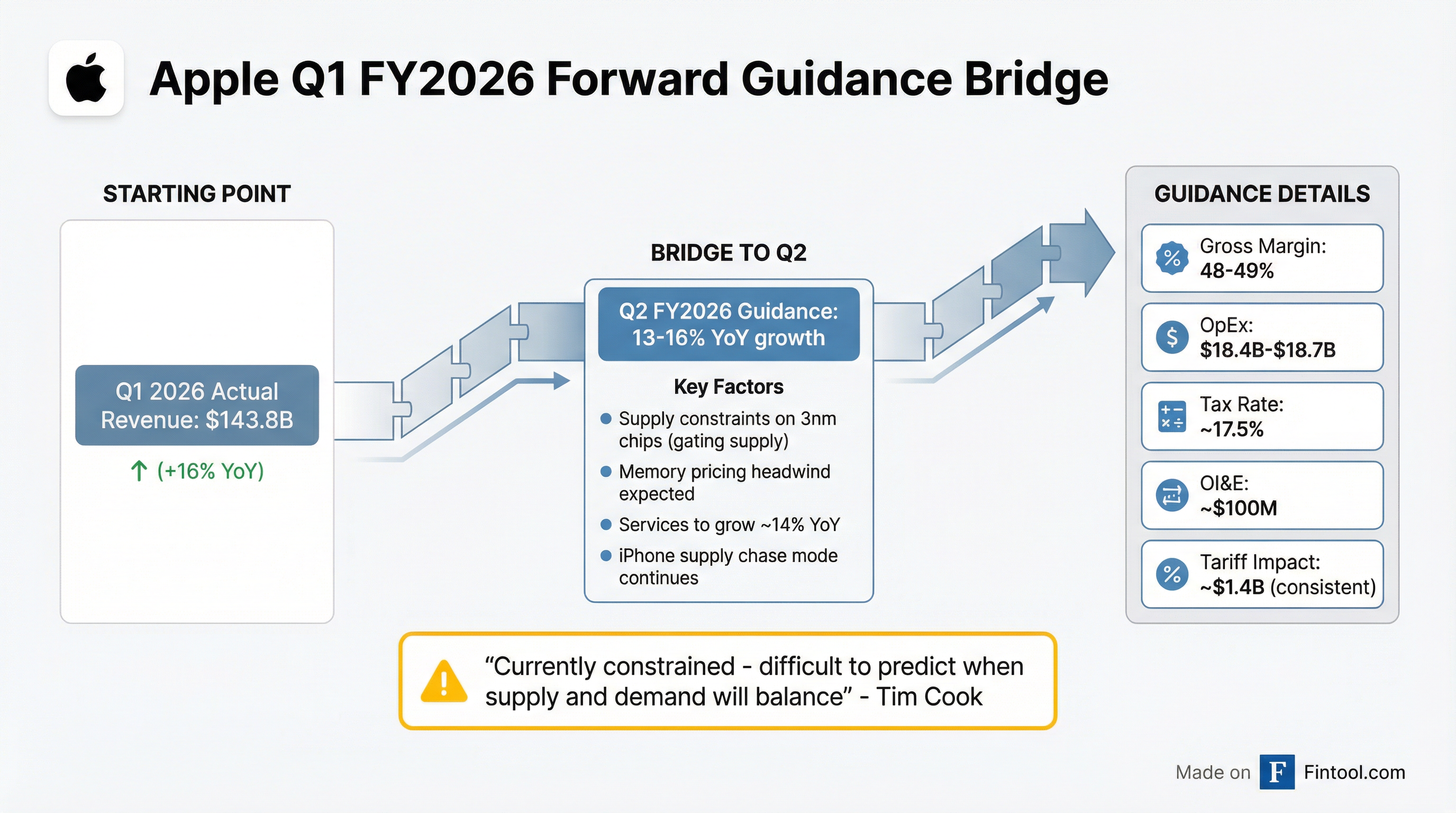
Key Assumption: The guidance assumes "global tariff rates, policies, and their application remain in effect as of this call, and the global macroeconomic outlook does not worsen from today."
Tariff impact was ~$1.4 billion in Q1 and expected to remain at similar levels.
Supply Constraints: The Key Risk
The biggest news from the Q&A was Apple's supply situation. Tim Cook was direct:
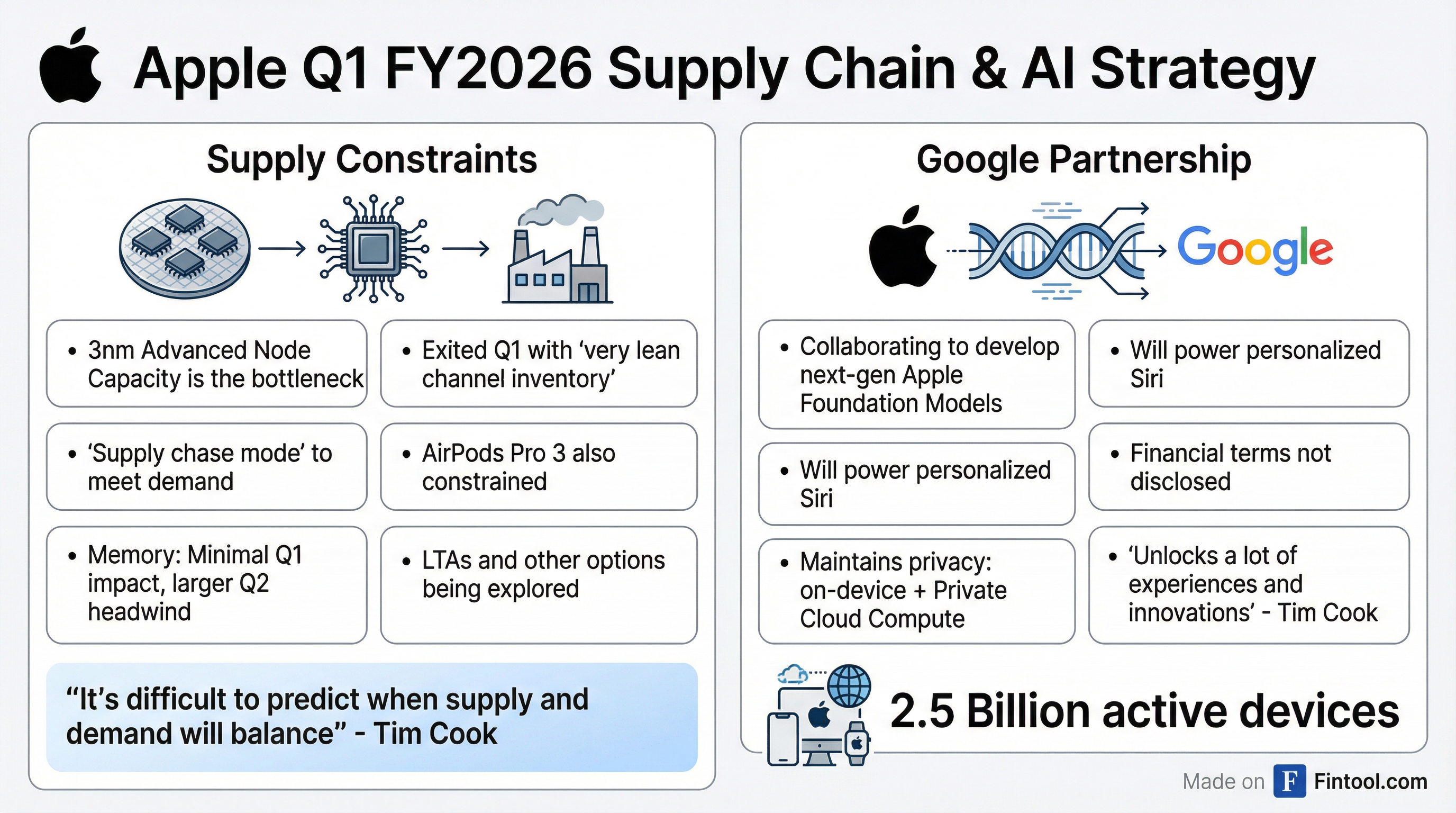
"We exited the December quarter with very lean channel inventory due to that staggering level of demand. And based on that, we're in a supply chase mode to meet the very high levels of customer demand. We are currently constrained, and at this point, it's difficult to predict when supply and demand will balance."
What's Causing the Constraint?
The bottleneck is advanced 3nm node capacity where Apple's SoCs are produced. Cook explained: "It's a direct result of the 23% growth and that far outstripping what we had internally estimated and having more limited flexibility in the supply chain."
Memory Pricing: A Growing Headwind
On memory costs, Cook provided detailed commentary:
When asked about pricing as a lever, Cook declined to speculate. He noted Apple is looking at "a range of options" to deal with memory pricing pressures.
Google Partnership: Next-Gen Siri
Apple announced a collaboration with Google to develop next-generation Apple Foundation Models:
"We basically determined that Google's AI technology would provide the most capable foundation for Apple Foundation Models. And we believe that we can unlock a lot of experiences and innovate in a key way due to the collaboration."
Key details:
- Will power a "more personalized Siri coming this year"
- Apple will continue running AI on-device and in Private Cloud Compute
- Privacy standards will be maintained
- Financial terms not disclosed
When asked about monetization of AI, Cook said: "We're bringing intelligence to more of what people love, and we're integrating it across the operating system in a personal and private way. I think that by doing so, it creates great value, and that opens up a range of opportunities across our products and services."
Apple Intelligence adoption: The majority of users on enabled iPhones are actively leveraging Apple Intelligence features.
Q&A Highlights
On iPhone Cycle Drivers
Analyst: Can you help us understand what the primary factors are driving strength in the iPhone?
Tim Cook: "It's a combination of things always that make the product sing. It's the display, it's the camera, it's the performance, it's the new selfie camera, it's the design. The design is beloved."
On Market Share Gains
Tim Cook: "We believe that based on the information that we've got is we gained share in the December quarter. Obviously, the market wasn't growing at 23%."
"If you look at Mac for the full calendar year of 2025, we also believe we gained share."
On CapEx and Private Cloud Compute
CFO Kevan Parekh noted Apple uses a "hybrid model" for CapEx leveraging both first and third-party capacity. He emphasized that last year Apple built out its Private Cloud Compute environment, and CapEx can be volatile independent of business performance.
On Gross Margin Resilience
Analyst: How are you doing it to keep gross margins at 48%-49%?
CFO Kevan Parekh: "When we have a good product cycle, strong product cycle, we're seeing for iPhone, that does lend itself to a bit more favorable opportunity on the mix and leverage side... We're seeing favorable mix dynamics."
Parekh also noted that investments in core technologies like Apple Silicon are "impacting gross margin in a positive way."
On AI-Capable Install Base
When asked what portion of the install base is AI-capable (iPhone 15 Pro or later), Parekh declined to provide a specific number but said it's "a growing number" and Apple is "encouraged by the amount of devices now that are capable."
Ask Fintool AI AgentMargins and Profitability
Apple delivered exceptional profitability alongside the revenue beat:
Operating expenses grew 19% YoY, driven by increased R&D investment.
Cash Flow and Capital Returns
Apple's cash generation remained exceptional:
The Board declared a $0.26 per share dividend, payable February 12, 2026, to shareholders of record as of February 9, 2026.
How Did the Stock React?
Apple shares closed at $258.28 in regular trading (+0.7%) and traded at $259.62 in after-hours (+0.5% from close).
The muted reaction despite the blowout results may reflect supply concerns voiced in the Q&A and the already-high expectations heading into the print.
What Changed From Last Quarter?
The most significant change is the dramatic acceleration in China — from solid 12% growth last quarter to a stunning 38% this quarter. The supply constraint disclosure is also new; Apple was not previously flagging 3nm capacity as a gating factor.
Forward Estimates
*Values retrieved from S&P Global (pre-earnings consensus)
Note: Consensus will likely be revised higher following today's results.
Key Risks and Watch Items
- Supply constraints: 3nm node capacity is the bottleneck; no timeline to balance
- Memory pricing: Headwind expected to grow beyond Q2
- Tariff exposure: ~$1.4B quarterly impact assumed in guidance
- AI execution: Google partnership must deliver on personalized Siri promise
- China sustainability: Can Apple maintain 38% growth as Huawei pushes back?
- Wearables weakness: Segment declined 2% even excluding constraints
The Bottom Line
Apple delivered a blowout quarter that exceeded already-elevated expectations. The 23% iPhone growth and 38% China surge are the headline numbers, but the real story is Apple's execution across every metric — revenue, margins, cash flow, and shareholder returns.
The Q&A added important context: Apple is supply constrained on 3nm capacity with no clear timeline to balance, memory costs are rising, and the Google partnership signals a new chapter for Siri. The muted stock reaction (+0.7%) may reflect investor focus on the supply headwinds rather than the record results.
For long-term investors, the fundamentals couldn't be cleaner: record iPhone cycle, services at $30B, 2.5 billion active devices, and margin expansion despite cost pressures. Apple enters 2026 with unprecedented momentum — if it can secure the chips.
Ask Fintool AI AgentData sources: Apple Inc. Q1 FY2026 Earnings Call Transcript , S&P Global consensus estimates. Analysis as of January 29, 2026.